Showing posts with label potential energy. Show all posts

11 February 2008

Question: Electric PE could be 0? This is very distrurbing...

I know we have down tons of questions where we have to find where V is zero (or similar like it..)

I never made the connection until now that V =0 means the electric potential energy at that point is 0 too! This is deeply disturbing.

Does this mean that if say a charge move between two other charges.. suddenly, middle of the way, it losts all of its potential energy? It is certain possible for V to be zero, which would imply electric PE be 0 as a consequence.

I am so used to the potential energy in a gravitational sense, where potential energy is 0 only when you hit the bottom.. This is like jumping off the a building then middle of the way, finding all of your potential energy all gone of a sudden. Where did it go?


Disturbing indeed.

Rest assured, physics is not broken, but there are two interesting points to be made here.

Firstly, while the analogy to gravitational energy is a good one, it is incomplete due to the fact that there is no negative mass, but there are indeed negative charges. This means that the potential surface can dip below zero such that a local minimum in potential energy may very well be "beyond zero". Really what the universe seeks is minima, not "zero", especially since we can arbitrarily choose where zero is (think about gravitational energy and choosing the top of a cliff to be at zero PE... one still loses PE if one falls to the bottom).

Secondly, what matters in terms of motion is force, not PE, and that is related to the slope of the potential surface, not the "value" of it.

Let's look at a potential map:


I started this off with some small rectangular regions at set voltage (these could be metal plates held at a potential for example) and then calculated the potential in between. We can see that there are some "hills" (white, or lighter yellow) and some "valleys" (darker shades) and a gradient in between representing a smooth potential surface (ignore the pixellation, I didn't calculate this on a very fine mesh).

In particular, take a look at the region between the highest positive potential and the lowest negative potential. We can see that there is an equipotential line running between them at V=0. But, if we think of this like an elevation map that V=0 crossing is on the middle of a hill! A positive charge (we would invert the map for a negative charge) moving across this potential surface would act like a marble rolling on an elevation map. If we put it on top of the white hill of +2V it would roll down into the -5V valley, still experiencing a force due to the electric field as it passed through 0V.

So, "zero potential" is a somewhat arbitrary thing, and because of negative charges it comes up naturally more often for electrostatic potential that you might be used to from gravitation. Also, the force, the thing which drives motion, is related to the slope (really a directional kind of slope which senses the steepest change).

The very useful thing about electrostatic "potential" is that it gives a convenient way to map out the landscape that a charge will "see" without reference to that charge, just as electric field maps out the force a charge would experience without reference to that charge, and the two are related by slope. Such a map can give an intuitive feel for what will happen when a charge is introduced even for complex arrangements of charges or plates.

I hope that helps. This is far from a complete explanation, so feel free to stimulate further discussion in the comments here!

31 January 2007

"Potential" for confusion: Electrostatic potential and potential energy

Let's start at the beginning:

Electric Potential Energy, like any other potential energy, is defined in relation to a conservative force: in this case, the electrostatic force. If one moves a charge from one point to another through an electric field, one must exert a force over this distance... hence work has been done, which corresponds to a difference in the potential energy.

The electric PE at a given point is generally defined relative to a point at infinity; ie. infinitely far away from the influence of any other charges. This is why we talk about "bringing charges in from infinity" to calculate the potential energy of an arrangement of charges.

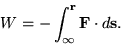
One additional complication with electric potential energy compared to graviational potential energy is that charges have different signs. That means that the forces which lead to the potential energy can be either attractive or repulsive. It is perhaps worth drawing from the vector definintion of work:


which tells us that we consider only the contributions of the force which are parallel (or antiparallel) to the path. The result? If we are moving the particle on a path parallel to the force on that particle (the force is acting in the same direction we are moving the particle), the work done by the force will be positive, and the potential energy will decrease. Since we are starting at infinity where the PE is zero, this means we will end up with a negative PE. Conversely, if we are moving the particle in countering the force (the force and direction are anti-parallel) then the resulting PE will be positive.

In this way we can think of PE around charges as hills and valleys: if the force between the "active" particle and another in the arrangement is attractive we will have a potential energy valley, but if the force is repulsive we have a potential energy hill. Let's hold onto this landscape idea and revisit it in relation to electric potential.

Electric, or electrostatic, Potential is the electrostatic potential per unit charge. Think of it as: electric potiential is to electrostatic PE, as electric field is to electrostatic force. That means that the electric potential takes on all the same characteristics as the electrostatic potential: it is a scalar quantity, it can be positive or negative depending on whether the interaction is repulsive or attractive.

Like the electric field, the sign will be determined by considering a positive test charge. With electric field, the direction of the vector quantity is determined by the direction of a force on a positive test charge. Since electric potential doesn't have a direction, it is just the sign which is determined by the positive test charge.

Let's return to our landscape idea then... with PE, we have to consider the magnitude and sign of the charge we are describing, however, since electric potential is per unit charge, it will always remain the same (unless the charges defining the landscape move). Since the positive test charge will be attracted by negative charges, there will be "valleys", or regions of negative potential near these, and near positive charges there will be "hills", or regions of positive potential. In this way, electric potential is kind of a measure of the attractiveness and repulsiveness of a position... just remember that it will be opposite for a negative charge.

I hope I've helped, and not muddled the situation further. Please post a comment if you wish some clarification.

I have some other resources posted for you on the topic of electric potential and potential energy for further reading:

23 January 2007

Topic open: Electric Potential and Potential Energy

The following topic is now open for questions: Electrostatic Potential and Potential Energy.

To pose a question, please post a comment to this post by clicking on the comments link below.

25 January 2006

Question: 2 Charges Dropped in an Electric Field (Chapter 17, #68)

I am confused on what the equation for conservation of energy should be for this problem....Should we consider potential energy due to the height?

For example I assumed the equation to be: mgh(before)+PE(before)=KE(after)

The question states: "Near the surface of the Earth there is an electric field of about 150V/m which points downward. Two identical balls with mass m=0.540kg are dropped from at height of 2.00m, but one of the balls is positively charged with q1=650μC, and the second is negatively charged with q2=-650μC. Use conservation of energy to determine the difference in the speed of the two balls when they hit the ground."


Whoo-ee! That's a nice problem, it incorporates several different ideas, just the kind I hated as a student, and see the value of now when I teach. :)

Your energy equation is mostly correct, but we need to figure out the signs of the energies.

Let's first draw a diagram, because I find that problem a mouth full. (I will put in the electrostatic forces, but not gravitational... we all know that points downward anyway).


So we have the positive charge (drawn on the left) experiencing a downward force due to the electric field, thus as it falls (down) it's electric potential energy will be decreasing, just as it's gravitational potential energy will be decreasing. However, for the negative charge (drawn on the right), the electrostatic force is pointing upward, opposing the falling motion, so it's electric potential will increase as it falls.

We will have to look at the conservation of energy each charge separately. Let's start with the positive charge:

PE(electric)+PE(gravitational)=KE
qEh+mgh=(1/2)mv12

(note that I used h for the distance the charge travels through the electric field).

Now let's look at the negative charge:

PE(gravitational)=KE+PE(electric)
mgh=(1/2)mv22+qEh

When plugging in the numbers, disregard the sign of the charge. I have included it already by determing whether the electric potential energy increases or decreases. Alternatively you could have used the energy equation for the first charge and plugged in the sign of the charge to get the same thing. Personally, to avoid confusion with signs, I think it's better to work through the logic of what's going on than to plug in signs, but that doesn't make the other way wrong.

So, using the energy equations for each ball, you can solve for the final velocities. I have confidence that you can all plug in numbers, so I will leave it at that. Hope this helps, and if you have any further questions feel free to post a comment.

Question: Increase plate separation, increase energy stored in capacitor

If two plates of a capacitor with constant charge have their separation doubled, the energy stored also doubles. I'm confused as to why this happens, since I thought E-stored was related to C, and C decreased as distance of separation increased. I'm looking at the equation Energy Stored = 0.5CV^2.


You are right that the energy stored in a capacitor if related to C, the capacitance. However, you have to consider what is being held constant as the separation doubles. If you look at the equation: U=(1/2)CV2, you will notice that U is proportional to C, however you have a factor of V2 that changes in a way you can't determine directly. If instead, you re-write the equation substituting in V=Q/C, so that you have: U=(1/2)Q2/C, then you know that Q is a constant, so we can talk about U being proportional to 1/C. Thus, as C decreases, U increases.

It might help you to look at the example I posted on this if you haven't already: Chapter 17, #50. Note also that since the amount of energy stored in the capacitor is increased, work must be done to increase the separation between the plates.

10 January 2006

Topic open: Electrostatic Potential and Potential Energy

The following topic is now open for questions: Electrostatic Potential and Potential Energy.

To pose a question, please post a comment to this post by clicking on the comments link below.