Showing posts with label electrostatics. Show all posts

11 February 2008

Question: Electric PE could be 0? This is very distrurbing...

I know we have down tons of questions where we have to find where V is zero (or similar like it..)

I never made the connection until now that V =0 means the electric potential energy at that point is 0 too! This is deeply disturbing.

Does this mean that if say a charge move between two other charges.. suddenly, middle of the way, it losts all of its potential energy? It is certain possible for V to be zero, which would imply electric PE be 0 as a consequence.

I am so used to the potential energy in a gravitational sense, where potential energy is 0 only when you hit the bottom.. This is like jumping off the a building then middle of the way, finding all of your potential energy all gone of a sudden. Where did it go?


Disturbing indeed.

Rest assured, physics is not broken, but there are two interesting points to be made here.

Firstly, while the analogy to gravitational energy is a good one, it is incomplete due to the fact that there is no negative mass, but there are indeed negative charges. This means that the potential surface can dip below zero such that a local minimum in potential energy may very well be "beyond zero". Really what the universe seeks is minima, not "zero", especially since we can arbitrarily choose where zero is (think about gravitational energy and choosing the top of a cliff to be at zero PE... one still loses PE if one falls to the bottom).

Secondly, what matters in terms of motion is force, not PE, and that is related to the slope of the potential surface, not the "value" of it.

Let's look at a potential map:


I started this off with some small rectangular regions at set voltage (these could be metal plates held at a potential for example) and then calculated the potential in between. We can see that there are some "hills" (white, or lighter yellow) and some "valleys" (darker shades) and a gradient in between representing a smooth potential surface (ignore the pixellation, I didn't calculate this on a very fine mesh).

In particular, take a look at the region between the highest positive potential and the lowest negative potential. We can see that there is an equipotential line running between them at V=0. But, if we think of this like an elevation map that V=0 crossing is on the middle of a hill! A positive charge (we would invert the map for a negative charge) moving across this potential surface would act like a marble rolling on an elevation map. If we put it on top of the white hill of +2V it would roll down into the -5V valley, still experiencing a force due to the electric field as it passed through 0V.

So, "zero potential" is a somewhat arbitrary thing, and because of negative charges it comes up naturally more often for electrostatic potential that you might be used to from gravitation. Also, the force, the thing which drives motion, is related to the slope (really a directional kind of slope which senses the steepest change).

The very useful thing about electrostatic "potential" is that it gives a convenient way to map out the landscape that a charge will "see" without reference to that charge, just as electric field maps out the force a charge would experience without reference to that charge, and the two are related by slope. Such a map can give an intuitive feel for what will happen when a charge is introduced even for complex arrangements of charges or plates.

I hope that helps. This is far from a complete explanation, so feel free to stimulate further discussion in the comments here!

04 February 2008

Topic open: Electric fields, potentials and capacitors

The following topic is now open for discussion: Electric fields, potentials, capacitors and parallel plates

If you have a question regarding this topic, please post a comment to this post by clicking on the comment link below.

Electric fields and electrostatic potential

I've had an interesting discussion regarding Electric field and Electric potential and thought I would repost it here so it wasn't buried in the comments of an old post...

In relation to the post Question: E=V/d or V=-Ed? (to minus or not to minus), Peter asked:

Hey, I was just reading Cutnell & Johnson Physics 7th edition (Competitor textbook to Giancoli) and on pg 585 it had some comments about this. I am not sure if it is applicable?

They first derived the -form of the equation. So they said
W = Fd =qEd
But W = -PE

qEd = -PE

qEd/q = -PE/q

Ed = -V

V = -Ed

Ok so far so good.

then they had some comments about the form of the equation where V = Ed (no negative sign)

"When applied strictly to a parallel plate capacitor, however, this expression is often used in a slight different form. In figure 19.16, the metal plates of the capacitor are marked A( higher potential) and B (lower potential). Traditionally, in discussions of such a capacitor, the potential difference between the plates is referred to by using the symbol V to denote the amount by which the higher potential exceeds the lower potential. V = Va-Vb.

Thus,

E = -V/d = - (Vb-Va)/d = (Va-Vb)/d = V/d.

Would this be a valid explanation as well since in this course we are mostly dealing with parallel plate capacitors? Thanks.


Hi Peter,

Excellent idea to check out another text book, sometimes a different perspective is all you need...

However, I disagree with Cutnell's approach here. They are essentially taking advantage of two negatives which cancel, and I think it is confusing. It is true that, as a sort of shorthand, the potential difference between the plates is simply given as the amount by which the higher potential exceeds the lower. The problem I see with using this "no minus" version of the equation is that it does not represent the true relationship between E and V (ie. that the electric field points from the high potential to the low potential). This takes a relationship and turns it into an equation, which I dislike. Equations are limited in scope and easy to misapply, relationships can give you better understanding which is a much more solid basis.

I'd rather see you sketch a diagram showing the high and low potential and where the positive and negative charges are separated on the two plates and applying the "V" given as the magnitude of the potential difference. It will be much harder to go wrong with this picture in front of you, and the whole "-" issue more or less disappears.

I hope that helps.


Gee you are totally right. I posted this early this morning and now I already have a different idea, which you have already hinted here but I want to make sure I got this down 100%.

This just came to me.


Is this way of thinking correct?

Thanks!


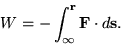
Which is exactly right. In fact, the "full" form (using vector calculus) is given by:


which essentially says to add up (integrate) the components of the electric field parallel to the path taken (the dl). If the electric field is constant and the path is straight, then everything reduces to what we have above.

Conversely, the electric field is proportional to a sort of directional slope of the potential (called the gradient) such that the greatest forces will be felt by charges in the "steepest" regions of electrostatic potential. More on that later perhaps...

29 January 2008

Topic open: Electric Potential and Potential Energy

The following topic is now open for discussion: Electric Potential and Potential Energy.

If you have a question regarding this topic, please post a comment to this post by clicking on the comment link below.

10 January 2008

Topic open: Forces on charges and Electric fields

The following topic is now open for discussion: Forces on charges and Electric fields.

If you have a question regarding this topic, please post a comment to this post by clicking on the comment link below.

New Example! Chapter 16 #15

Now posted on the main WebTA site:

Chapter 16, #15

Before heading over to check it out, I suggest you try it yourself and then take a look.

31 January 2007

"Potential" for confusion: Electrostatic potential and potential energy

Let's start at the beginning:

Electric Potential Energy, like any other potential energy, is defined in relation to a conservative force: in this case, the electrostatic force. If one moves a charge from one point to another through an electric field, one must exert a force over this distance... hence work has been done, which corresponds to a difference in the potential energy.

The electric PE at a given point is generally defined relative to a point at infinity; ie. infinitely far away from the influence of any other charges. This is why we talk about "bringing charges in from infinity" to calculate the potential energy of an arrangement of charges.

One additional complication with electric potential energy compared to graviational potential energy is that charges have different signs. That means that the forces which lead to the potential energy can be either attractive or repulsive. It is perhaps worth drawing from the vector definintion of work:


which tells us that we consider only the contributions of the force which are parallel (or antiparallel) to the path. The result? If we are moving the particle on a path parallel to the force on that particle (the force is acting in the same direction we are moving the particle), the work done by the force will be positive, and the potential energy will decrease. Since we are starting at infinity where the PE is zero, this means we will end up with a negative PE. Conversely, if we are moving the particle in countering the force (the force and direction are anti-parallel) then the resulting PE will be positive.

In this way we can think of PE around charges as hills and valleys: if the force between the "active" particle and another in the arrangement is attractive we will have a potential energy valley, but if the force is repulsive we have a potential energy hill. Let's hold onto this landscape idea and revisit it in relation to electric potential.

Electric, or electrostatic, Potential is the electrostatic potential per unit charge. Think of it as: electric potiential is to electrostatic PE, as electric field is to electrostatic force. That means that the electric potential takes on all the same characteristics as the electrostatic potential: it is a scalar quantity, it can be positive or negative depending on whether the interaction is repulsive or attractive.

Like the electric field, the sign will be determined by considering a positive test charge. With electric field, the direction of the vector quantity is determined by the direction of a force on a positive test charge. Since electric potential doesn't have a direction, it is just the sign which is determined by the positive test charge.

Let's return to our landscape idea then... with PE, we have to consider the magnitude and sign of the charge we are describing, however, since electric potential is per unit charge, it will always remain the same (unless the charges defining the landscape move). Since the positive test charge will be attracted by negative charges, there will be "valleys", or regions of negative potential near these, and near positive charges there will be "hills", or regions of positive potential. In this way, electric potential is kind of a measure of the attractiveness and repulsiveness of a position... just remember that it will be opposite for a negative charge.

I hope I've helped, and not muddled the situation further. Please post a comment if you wish some clarification.

I have some other resources posted for you on the topic of electric potential and potential energy for further reading:

09 January 2007

Topic open: Forces on charges and Electric fields

The following topic is now open for discussion: Forces on charges and Electric fields.

If you have a question regarding this topic, please post a comment to this post by clicking on the comment link below.

10 April 2006

Correction: Example Ch 16 #61

Sorry, there is an error in the example posted on the main page: Electrostatics / Ch. 16 #61

In the first part, I forgot to square the velocity, so instead of 5.4e-9 m, I should have gotten a distance of 0.115 m. The error is also carried forward into part b, instead of 1e-12 s, I should have gotten 2e-8 s for the time.

I will try to fix the original page soon.

27 January 2006

Question: E=V/d or V=-Ed? (to minus or not to minus)

I was wondering why the notes from class say that for uniform Electric fields E=V/d, while the textbook and WebTA say that V=-Ed. Why is there no negative sign in the one case, but the negative is included in the other?


That is a very good question. I can first tell you that the reason my formula and the formula in the book are the same is that I copied mine out of the book. ;) I can also say that Prof. Altounian's notes are correct.

To get to the heart of this matter, really we have to think about what V is and what E is. The electric potential, V, is a scalar quantity. That is, it has a magnitude at a particular point in space, but no direction associated with it. But the electric field, E, is a vector quantity. This means it has both a magnitude and a direction. So if we look at a simple formula for the electric field, like E=V/d, we have to think this isn't the full story... how do we relate a vector and a scalar?? where is the direction part of E??? Well, it isn't there. Really all we get is the magnitude of E. So, whether you stick a negative sign there or not, you have to determine the direction of the electric field in another way (by determing where a high potential is and where a low potential is).

So, why did the text book (and myself) bother putting a negative sign there? Well, it comes from the calculus relation between E and V. If you have a map of V over an area, the electric field points downhill, so when you look at it from within a differential formalism you need the negative sign (so I'm used to seeing it that way).

In any case, I mean to change my webTA pages to agree with the class notes on this point. And the moral of the story is that since E is a vector you have to determine the direction as well as the magnitude.

25 January 2006

Question: 2 Charges Dropped in an Electric Field (Chapter 17, #68)

I am confused on what the equation for conservation of energy should be for this problem....Should we consider potential energy due to the height?

For example I assumed the equation to be: mgh(before)+PE(before)=KE(after)

The question states: "Near the surface of the Earth there is an electric field of about 150V/m which points downward. Two identical balls with mass m=0.540kg are dropped from at height of 2.00m, but one of the balls is positively charged with q1=650μC, and the second is negatively charged with q2=-650μC. Use conservation of energy to determine the difference in the speed of the two balls when they hit the ground."


Whoo-ee! That's a nice problem, it incorporates several different ideas, just the kind I hated as a student, and see the value of now when I teach. :)

Your energy equation is mostly correct, but we need to figure out the signs of the energies.

Let's first draw a diagram, because I find that problem a mouth full. (I will put in the electrostatic forces, but not gravitational... we all know that points downward anyway).


So we have the positive charge (drawn on the left) experiencing a downward force due to the electric field, thus as it falls (down) it's electric potential energy will be decreasing, just as it's gravitational potential energy will be decreasing. However, for the negative charge (drawn on the right), the electrostatic force is pointing upward, opposing the falling motion, so it's electric potential will increase as it falls.

We will have to look at the conservation of energy each charge separately. Let's start with the positive charge:

PE(electric)+PE(gravitational)=KE
qEh+mgh=(1/2)mv12

(note that I used h for the distance the charge travels through the electric field).

Now let's look at the negative charge:

PE(gravitational)=KE+PE(electric)
mgh=(1/2)mv22+qEh

When plugging in the numbers, disregard the sign of the charge. I have included it already by determing whether the electric potential energy increases or decreases. Alternatively you could have used the energy equation for the first charge and plugged in the sign of the charge to get the same thing. Personally, to avoid confusion with signs, I think it's better to work through the logic of what's going on than to plug in signs, but that doesn't make the other way wrong.

So, using the energy equations for each ball, you can solve for the final velocities. I have confidence that you can all plug in numbers, so I will leave it at that. Hope this helps, and if you have any further questions feel free to post a comment.

17 January 2006

Question: One charge, E-field and force

Hi, I was wondering how to calculate both a force and an electric field when you're only given one charge. For example, if I have a positive test charge q, and a positive charage Q1 r distance away from the test charge... I'm confused on how I can calculate the force vector (resultant) in order to set up a triangle and find the x and y components of the force (same for electric fields).


If you are given only one charge, and no electric field anywhere due to some other arrangement of charges, then all you can do is calculate the electric field due to that one charge. In this case, you can determine the electric field at a point some distance (r) away. The direction of the electric field will be the same as a force would be on a positive charge if you put one there, but the magnitude of this test charge (q) is divided out (E=F/q). Remember that for a point charge, the electric field points radially outward/inward from the positive/negative charge. This makes sense if you think about putting a positive test charge anywhere around the charge you are given, as the force between the two will be along the direction of the separation.

You might also be asked about a charge in an electric field (usually a uniform one, since that's easiest to deal with). In this case you can determine the force on the charge due to this external electric field by making use of the definition of electric field: E=F/q. Flip this around, and you have: F=Eq, which can be very useful. Let's say you have an electron in a 1 V/m (N/C) uniform electric field pointing north. The magnitude of the force on the electron will be: F=(1N/C)(1.6e-19C)=1.6e-19N. The direction of the force will be south, since the electron is negatively charged and the direction of E is defined as the direction of force on a positive charge.

I hope this helps, please follow-up if I haven't answered your question here.

Question: Charge transfered between plastic balls (Ch 16, #22)

i have an r, an F and constant k....im not sure how to go about this, but i solve for Q1*Q2, and then not sure where to go from there. if the first ball is uncharged , does that mean Q1 is 0 coulombs?

The question states: "A charge Q is transferred from one ball to an identical ball 12 cm away. The force of attraction is then 17 mN. How many electrons were transferred from one ball to the other?"


So, the key thing to pick up on here is that the balls are initially uncharged (Q1=Q2=0). This means that after charge is transferred between the two balls the net charge, Q1+Q2, will be zero. If we use this fact, we can see that Q1=-Q2. So, since a charge is transferred from one ball to the other each now has an equal but opposite charge, let's call it Δq. So, we can say that Q1 now has a charge of +Δq (a positive charge), and Q2 now has a charge of -Δq (a negative charge).

Now we can use the equation for the electrostatic force between two point charges to solve for Δq as you suggest.

It is worth noting that there were two ways we could have determined that the balls had opposite charge from what is given in the question. We used the fact that the balls are uncharged, telling us that the net charge after transfer is zero. We could also have used the fact that the force is attractive to determine that the balls are oppositely charged. But... we still would have needed to know that the magnitude of the charge on each was equal from the zero net charge. Often though, the wording of a question contains more information than you might suspect at first glance, so it is worth looking for hints like this.

You might also find the following posted example helpful: Chapter 16, #21 which also involves two charged spheres. The only difference is that in this example the net charge of the two sphere is not zero.

12 January 2006

Question: Charged droplet in an Electric Field


we encountered a problem where a charged droplet remains stationary above the earth, the electric field of the earth is given and its asks how many excess electrons are in the droplet.

so i assumed that since there is no movement there has to be no net electric field. so i assumed the electric field of the droplet is also 145 n/c just negative. i used the equation kQ/r^2 = electric field. so i multiplied 145 by the square of the radius and i divided it by the constant k to get the total charge of the droplet. then i divided that by 1.602 E-19 to get the number of electrons present, but i still could not get the right answer, what was i doing wrong?


You are right that there has to be zero net something, however, it isn't the Electric field that cancels to suspend the drop, it is the net Force on the droplet that has to be zero to establish static equilibrium. So, let's think about what forces are exerted on the droplet here. Firstly, there is a force of gravity exerted down on the drop since it is suspended above the Earth. Secondly, because the droplet is charged and is in an Electric field, it will feel a force due to this Electric field. We know that this force must point "up" (ie. oppose gravity), so we can determine from this the sign of the charge. Since the Electric field of the Earth points "down" (radially inward, gravity points radially inward), and the direction of the Electric field is defined as the direction of the force on a positive point charge, the charge of the particle will have to be negative. We can now draw a diagram to make this more clear:


The electric force is Fel=qE. We know E (it is given in the problem), and we are looking for q. For the gravitational force we need to do a bit of work if the mass isn't given directly. Since we know the size (radius) of the drop, we can calculate it's mass from the density, ρ, and volume, V=(4/3)πr3: m=ρV. Then we have all the pieces we need.

It should be noted that the equation for the electric field due to a point charge cannot be used in the way you tried to use it. E=kQ/r2 is the Electric field due to a point charge with charge, Q, at a distance, r, away.


Hope this is helpful to you, if you have follow-up questions don't hesitate to comment on my answer here. Thank-you for being the first to ask a question!

10 January 2006

Topic open: Electrostatic Potential and Potential Energy

The following topic is now open for questions: Electrostatic Potential and Potential Energy.

To pose a question, please post a comment to this post by clicking on the comments link below.

09 January 2006

Topic open: Forces on charges and Electric fields

The following topic is now open for discussion: Forces on charges and Electric fields.

If you have a question regarding this topic, please post a comment to this post by clicking on the comment link below.